
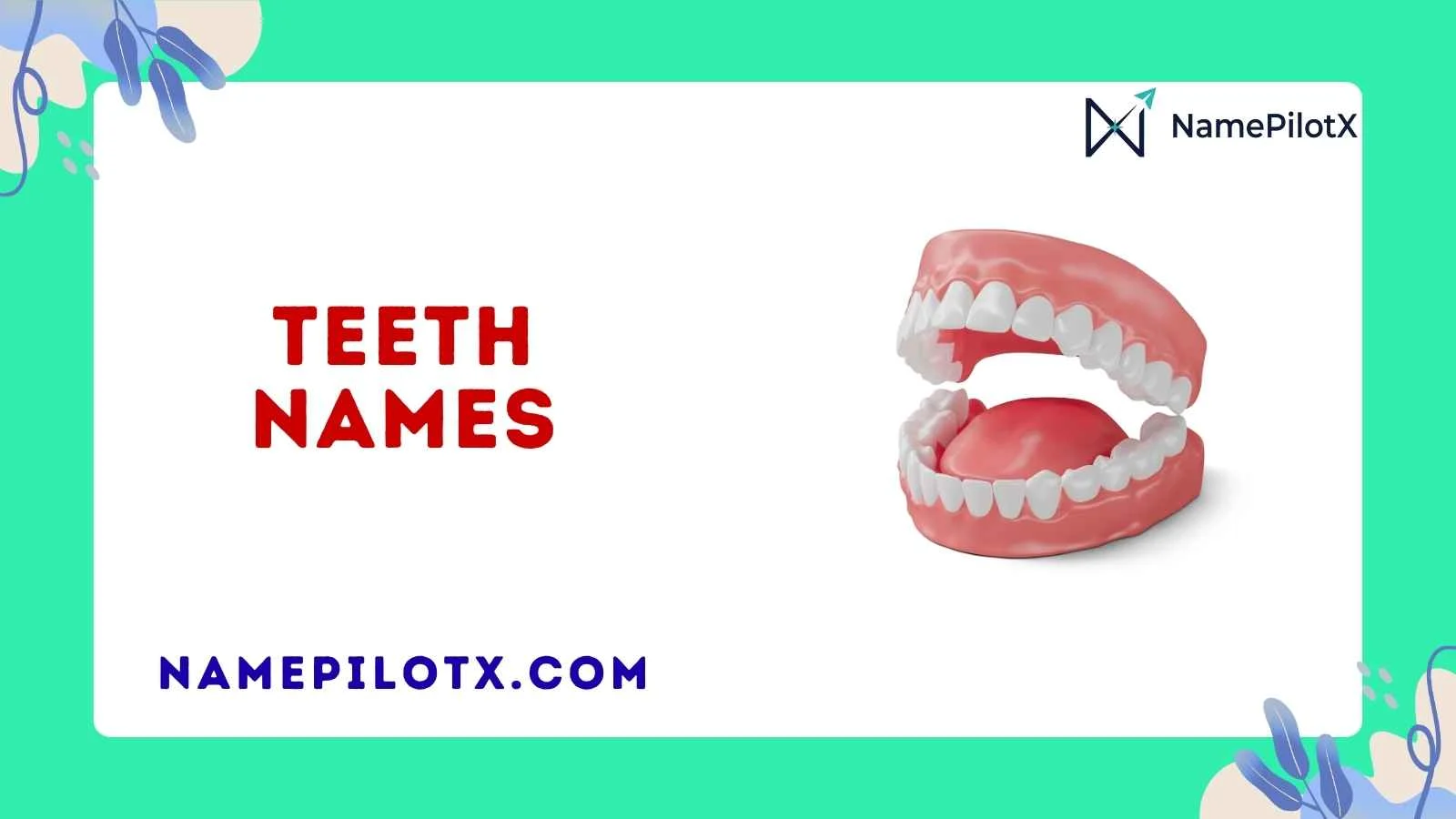
Your teeth may look like one complete set, but each tooth has a different job. Some teeth slice food. Others tear it, crush it, or grind it into smaller pieces.
Knowing the names of teeth can make dental charts, school lessons, and conversations with your dentist much easier to understand.
Humans develop two main sets of teeth during life. The first set is called primary or baby teeth. The second is the permanent set that usually replaces them as children grow.
So, what are the different teeth names, and what does each type do?
This guide breaks down the main types of human teeth in simple language. You will learn the names of teeth, where they are located, what they look like, and how they help you eat.
You will also see a clear teeth chart, understand baby teeth versus adult teeth, and learn common dental terms without getting buried in complicated science.
Featured Snippet ⚡
The best teeth names to know are incisors, canines, premolars, and molars. Incisors cut food, canines tear it, premolars crush it, and molars grind it. Adults usually have 32 permanent teeth, while children normally have 20 primary teeth. Each tooth type has a specific position and role.
Quick Tips About Teeth Names
- Incisors are the front teeth used mainly for cutting food.
- Canines sit beside the incisors and help tear food.
- Premolars crush and break food into smaller pieces.
- Molars are the large back teeth designed for grinding.
- Adults usually have 32 permanent teeth, including wisdom teeth.
- Children usually have 20 primary teeth.
- Teeth are named by both their type and position in the mouth.
- Upper teeth are located in the maxillary arch, while lower teeth are in the mandibular arch.
What Are the Different Types of Teeth Names?
There are four main types of human teeth: incisor, canines, premolars, and molars. Each type has a different shape because it performs a different task.
Incisors
Incisors are the teeth at the very front of the mouth. They have relatively thin, sharp edges that make them useful for biting and cutting food.
Most adults have eight permanent incisors. There are four in the upper jaw and four in the lower jaw.
The two teeth nearest the center of the mouth are called central incisors. The teeth beside them are lateral incisors.
Canines
Canines are located next to the lateral incisors. They are usually more pointed than the other front teeth.
Their main job is to grip and tear food. Permanent canines are also among the strongest teeth in the mouth because they have long roots.
There are four permanent canines in a typical adult mouth, with one on each side of the upper and lower jaws.
Premolars
Premolars are found between the canines and molars. They have broader surfaces than canines and are designed to crush and break food.
Adults normally have eight permanent premolars. Children do not have permanent premolars in their primary teeth because these teeth develop later.
Molars
Molars are the large teeth toward the back of the mouth. Their wide surfaces contain several raised areas that help grind food.
Most adults have 12 permanent molars if all four wisdom teeth are present. These include first molars, second molars, and third molars.
Want a simple way to remember the four main tooth types? Think cut, tear, crush, grind.
What Are the Names of Teeth in Order?
If you look at the mouth from the front toward the back, the teeth follow a basic pattern. In a typical adult quadrant, you will find a central incisor, lateral incisor, canine, first premolar, second premolar, first molar, second molar, and third molar.
This pattern occurs on both sides of the upper and lower jaws.
| Tooth name | Typical position | Main function | Permanent teeth |
|---|---|---|---|
| Central incisor | Front center | Cutting | 4 |
| Lateral incisor | Beside central incisor | Cutting | 4 |
| Canine | Beside lateral incisor | Tearing | 4 |
| First premolar | Behind canine | Crushing | 4 |
| Second premolar | Behind first premolar | Crushing | 4 |
| First molar | Back section | Grinding | 4 |
| Second molar | Behind first molar | Grinding | 4 |
| Third molar | Furthest back | Grinding | 4 |
The exact number can vary because some people naturally have missing teeth, extra teeth, or wisdom teeth that never erupt.
Understanding this order can make dental diagrams much easier to read.
What Are the 32 Permanent Teeth Names?
The adult human mouth can contain up to 32 permanent teeth. These are divided equally between the upper and lower jaws.
Each jaw normally contains 16 permanent teeth. On each side, there are two incisors, one canine, two premolars, and three molars.
| Tooth group | Upper jaw | Lower jaw | Total |
| Incisors | 4 | 4 | 8 |
| Canines | 2 | 2 | 4 |
| Premolars | 4 | 4 | 8 |
| Molars | 6 | 6 | 12 |
| Total | 16 | 16 | 32 |
The third molars are commonly called wisdom teeth. They are the final permanent teeth in the usual sequence.
Not everyone develops all four wisdom teeth. Some people have fewer, and some have none.
So when someone says they have 28 adult teeth, that does not automatically mean something is wrong. They may simply not have erupted wisdom teeth.
What Are the Names of Baby Teeth?
Baby teeth are also called primary teeth, deciduous teeth, or milk teeth. Children usually develop 20 primary teeth.
These teeth include incisors, canines, and molars. Primary teeth do not include premolars.
| Baby tooth type | Number |
| Central incisors | 4 |
| Lateral incisors | 4 |
| Canines | 4 |
| First molars | 4 |
| Second molars | 4 |
| Total | 20 |
Baby teeth help children chew food and speak clearly. They also hold space for many of the permanent teeth that develop underneath them.
Primary teeth eventually become loose and fall out as permanent teeth move into position.
Knowing baby teeth names can be especially helpful for parents trying to understand a child’s dental chart.
What Is the Difference Between Baby Teeth and Adult Teeth?
Baby teeth and permanent teeth serve similar basic purposes, but they differ in number, size, structure, and lifespan.
The biggest difference is the number of teeth. Children normally have 20 primary teeth, while adults can have up to 32 permanent teeth.
| Feature | Baby teeth | Permanent teeth |
| Common name | Primary teeth | Adult teeth |
| Typical number | 20 | Up to 32 |
| Premolars | No | Yes |
| Wisdom teeth | No | Yes, in some people |
| Lifespan | Temporary | Usually intended to last for life |
| Main role | Eating and speech | Eating, speech, and long-term oral function |
Baby teeth may be smaller and whiter than permanent teeth. Their roots also have characteristics that allow them to be replaced naturally.
This transition is an important part of normal dental development.
What Does Each Tooth Do?
Each tooth type has a specific function. The shape of a tooth is closely connected to the work it performs.
- Central incisors: Cut and bite food using their narrow edges.
- Lateral incisors: Help cut food and support the front teeth during biting.
- Canines: Grip and tear tougher foods.
- First premolars: Help crush food after it is torn.
- Second premolars: Continue crushing and breaking food.
- First molars: Grind food with their broad chewing surfaces.
- Second molars: Provide additional grinding power.
- Third molars: Can contribute to chewing when they erupt normally and function properly.
Teeth also support speech. The tongue, lips, and teeth work together to produce many sounds.
They also help maintain the shape of the lower face by supporting surrounding tissues.
So teeth are not simply tools for chewing. They contribute to several everyday functions.
What Are the Parts of a Tooth?
Knowing tooth names is useful, but understanding the main parts of a tooth gives you an even clearer picture.
| Tooth part | Simple meaning |
| Crown | Visible part above the gum |
| Root | Part anchored in the jaw |
| Enamel | Hard outer covering |
| Dentin | Layer beneath the enamel |
| Pulp | Inner area containing nerves and blood vessels |
| Cementum | Tissue covering much of the root |
| Periodontal ligament | Helps connect the tooth to surrounding bone |
Enamel is the hard outer layer that protects the tooth. Under it is dentin, which makes up much of the tooth structure.
At the center is the pulp, which contains nerves and blood vessels.
The root anchors the tooth in the jaw. Although you cannot normally see it, the root is essential for stability.
These parts work together to keep a tooth strong and functional.
How Are Teeth Numbered and Named by Dentists?
Dentists may use more than one system to identify individual teeth. Instead of always saying “upper right first molar,” a dental professional may use a number or letter.
In the United States, the Universal Numbering System assigns numbers to permanent teeth from 1 through 32. Primary teeth are commonly identified using letters A through T.
Another widely used system is the FDI World Dental Federation notation, which uses two-digit numbers.
For example, the first digit identifies the quadrant, while the second digit identifies the tooth’s position within that quadrant.
Dental numbering systems are useful because they make communication faster and more precise.
You do not need to memorize every code to understand your teeth. Knowing the basic tooth names is usually enough for everyday conversations.
Common Mistakes People Make About Teeth Names
Teeth names can sound simple, but several common misunderstandings cause confusion.
- Calling all back teeth molars: Premolars are also behind the canines but are different from molars.
- Assuming children have premolars: Primary teeth include molars, but not premolars.
- Thinking everyone has 32 teeth: Some adults have fewer teeth, especially if wisdom teeth are absent or removed.
- Calling wisdom teeth a separate fifth type: Wisdom teeth are third molars.
- Assuming baby teeth are unimportant: They support chewing, speech, and dental development.
- Mixing up canines and incisors: Canines are more pointed and sit beside the incisors.
- Thinking every tooth has the same shape: Tooth shape changes according to function.
- Confusing crown with the whole tooth: The crown is only the visible upper portion of a tooth.
A little vocabulary can make dental information much easier to understand.
How to Remember the Four Main Teeth Names
A simple memory trick can help you remember the four main tooth types.
Think about what happens when you eat an apple or a piece of food.
- Incisors → Cut
- Canines → Tear
- Premolars → Crush
- Molars → Grind
You can also remember their position from front to back:
Incisors → Canines → Premolars → Molars
This sequence works well for basic school lessons and everyday dental knowledge.
If you remember just these four words, you already know the foundation of human tooth anatomy.
Expert Tips for Understanding a Teeth Chart
A dental chart can look confusing at first, but a few simple habits make it easier.
- Start at the front center of the mouth.
- Identify the central incisors first.
- Move outward to the lateral incisors.
- Find the pointed canines next.
- Look behind the canines for premolars.
- Identify the large back teeth as molars.
- Check whether wisdom teeth are included.
- Notice whether the chart shows upper or lower teeth.
- Look for numbers or letters used by the dental office.
- Ask your dentist to explain unfamiliar abbreviations.
The key is to identify position first and name second. Once you know where a tooth sits, its name is much easier to remember.
FAQs:
What are the 4 main types of teeth?
The four main types of human teeth are incisors, canines, premolars, and molars. Incisors are used mainly for cutting, canines help tear food, premolars crush food, and molars grind it. These teeth have different shapes because each one is designed for a specific role in chewing.
How many teeth does an adult normally have?
An adult can have up to 32 permanent teeth, including four wisdom teeth. The usual breakdown is eight incisors, four canines, eight premolars, and 12 molars. However, some adults have fewer than 32 teeth because wisdom teeth may never develop, may not erupt, or may have been removed.
What are the names of baby teeth?
Children normally have 20 primary teeth. These include four central incisors, four lateral incisors, four canines, four first molars, and four second molars. Primary teeth are temporary and are gradually replaced by permanent teeth as a child’s jaw and mouth develop.
What are the teeth next to the front teeth called?
The teeth directly next to the central front incisors are called lateral incisors. Next to the lateral incisors are the canines. This means the basic order from the center of the mouth toward the back is central incisor, lateral incisor, canine, premolar, and molar.
Are wisdom teeth molars?
Yes. Wisdom teeth are the third molars. They are located at the very back of the mouth and are the last permanent teeth in the usual dental sequence. Some people do not develop wisdom teeth, while others may have teeth that remain impacted instead of fully erupting.
What is the difference between incisors and canines?
Incisors are the relatively flat front teeth designed mainly for cutting and biting. Canines are positioned beside the incisors and are usually more pointed. Their shape helps them grip and tear food. Both are important parts of the front section of the mouth.
Do children have premolars?
Children do not have primary premolars. Instead, their primary molars are eventually replaced by permanent premolars. This is one reason the names of baby teeth and adult teeth are not exactly the same. The permanent set contains four more teeth in each jaw than the primary set.
Why do teeth have different shapes?
Teeth have different shapes because they perform different jobs. Sharp-edged incisors cut, pointed canines tear, broader premolars crush, and large molars grind. This division of work helps the mouth process food efficiently before it is swallowed.
Conclusion:
Understanding teeth names does not have to feel like memorizing a dental textbook.
The four main types are easy to remember once you connect each name with its job: incisors cut, canines tear, premolars crush, and molars grind.
Adults can have up to 32 permanent teeth, while children usually have 20 primary teeth. Each tooth has a specific position, shape, and function.
Use the tables and simple sequence in this guide whenever you need to identify a tooth or understand a dental chart.
And if you are looking at a dental report, do not hesitate to ask your dentist what an unfamiliar tooth number or term means.

Hi, I’m Edward Montgomery, the creator behind namepilotx.com, where creativity meets inspiration and every name tells a story!
I’m passionate about names, funny names, and the joy of discovering the perfect name. My goal is to make choosing names fun by sharing entertaining, unique, creative, and hilarious name ideas for readers of all ages.
Whether you’re looking for a funny name, a unique idea, or a creative name to spark your imagination, you’re in the right place.
Stay creative, keep exploring, and let the naming adventure begin!